
It’s the Story, Stupid

How to turn mundane announcements into stories your audience and the media will actually care about.
One of the great dichotomies of working in public relations is that clients routinely forget to tell us their best stories.
We usually discover them in passing.
On a weekly call, someone casually mentions that next Thursday they’re hosting a hackathon where engineers, physicians and entrepreneurs will spend two days building AI agents to solve some incredibly difficult healthcare problems.
“Wait. You’re doing what?”
Meanwhile, three days later, an email arrives marked urgent because the company is launching a new product that looks remarkably similar to 20 other products already on the market.
And they want tier-1 coverage, but only have a tier-3 or 4 story.
This happens all the time.
Some of the most fascinating things happening inside organizations don’t register internally as news because everyone is too close to them. Meanwhile, things that are incredibly important to the company can feel incredibly important to everyone at the company and therefore must also be incredibly important to everyone else.
Unfortunately, that’s not how stories work.
It doesn’t mean the product announcement isn’t important. It might be enormously important to the company, its customers, its investors and its sales team.
It just might not be news.
And those are two very different things.
A reporter doesn’t care how important this is to you
I recently spent about two years working as a journalist, in part because after spending most of my career in PR, I wanted to get better at media relations and storytelling.
It was one of the most valuable exercises I’ve ever undertaken.
For years I had been pitching reporters. Now I had to pitch an editor as a reporter.
And I learned very quickly that I couldn’t walk into an editorial meeting and say:
“I found this company, and they’re doing something really cool.”
Cool.
So what?
I had to bring her a story.
Who was I going to interview? What was actually happening? Why would anyone care? Why did it matter right now? What evidence did I have that this wasn’t just some random thing I personally found interesting? Was there data? Was there a larger trend? Was there conflict? Was something changing? Was there a person at the center of it?
Essentially, I had to have most of the story figured out before she'd let me go report it.
And I remember thinking:
Oh. This explains a lot.
Because this is exactly what happens on the other side of the inbox when a PR person sends a reporter a pitch that basically says:
COMPANY X ANNOUNCES REVOLUTIONARY NEW THING
Okay.
What’s the story?
That’s an important distinction because, as PR professionals, every time we send a reporter something that isn’t relevant to them, we spend a little bit of credibility.
Pitch enough bad stories, and eventually you become the boy who cried wolf.
I want reporters I work with to open my emails. More importantly, I want them to think of me as someone who can source stories for them, not simply someone who sends them press releases.
Which is why I tend to follow a decision-making tree before deciding what to do with a potential story.
And the first question is deceptively simple.
Is this actually a good story?
Not:
Is this important to us?
Not:
Did the CEO ask us to announce it?
Not even:
Did we spend $4 million developing it?
The question is:
Is this a good story for the audience we’re trying to reach?
Would they find it useful, relevant, interesting, surprising or meaningful?
This is a surprisingly difficult question to answer when you have spent months or years working on something.
It’s also one reason I believe there is enormous value in having an agency partner you trust enough to disagree with you.
You need someone who understands your business, believes in what you’re doing and is still willing to look you in the eye and say:
“I don’t think this is a story.”
That’s not cynicism. That’s strategy.
And it doesn’t necessarily mean you shouldn’t talk about it.
Maybe it belongs on your website. Maybe customers should get an email about it. Maybe it’s useful to the sales team. Maybe it’s perfect for LinkedIn.
But before putting the entire communications machine behind it, there is another question worth asking:
Can we make it a better story?
Years ago, a client taught me just how important that question can be.
The coding school that wasn’t really a story
This was during the great proliferation of coding schools.
Coding bootcamps were everywhere. This was before generative AI came along and made learning to code feel a little more complicated.
Our client was launching another coding school.
They had also secured some funding.
The problem was that neither fact was particularly remarkable.
There were lots of coding schools. Lots of startups were raising money, and sadly the amount they raised wasn’t particularly noteworthy.
The client was understandably excited.
They wanted major national coverage.
So we were in the classic PR rock-and-hard-place scenario.
We could dutifully write a press release, build a giant media list, pitch everyone and hope somebody bit.
Or we could figure out whether there was actually a better story hiding somewhere.
So we started asking questions.
Eventually someone mentioned that the school’s first cohort was about to graduate.
Interesting.
“Tell us about the students.”
That’s when we found the story.
One student had been working as a custodian at Google. After going through the program, he landed a software job making roughly $85,000 a year.
Another was a former coal miner whose career was disappearing. He needed another way to support himself, went through the coding program, and landed a software-development job in the Midwest making roughly $75,000.
Now we had something.
Because suddenly this wasn’t really a story about another coding school. It was a story about economic mobility.
It was about people reinventing themselves.
It was about whether these coding schools that were popping up everywhere could actually deliver on this enormous promise they were making: Give us a few months, and we can help change the trajectory of your career.
So we got their backgrounds. We interviewed them. We gathered photos. We researched the larger trend.
Most importantly, we stopped making the company the hero.
The students were the heroes.
If you want to apply the hero’s journey, the company was the mentor or sage. They were Obi-Wan handing Luke a lightsaber. They provided the tools, knowledge and opportunity that helped someone else continue the journey.
That’s a much more interesting role for a company to play.
The funding and launch were still there. They just became supporting facts instead of the story.
And it worked.
The story generated coverage in VentureBeat, Entrepreneur and Fast Company.
Same company.
Same launch.
Same funding.
Completely different story.
The Story Decision Tree
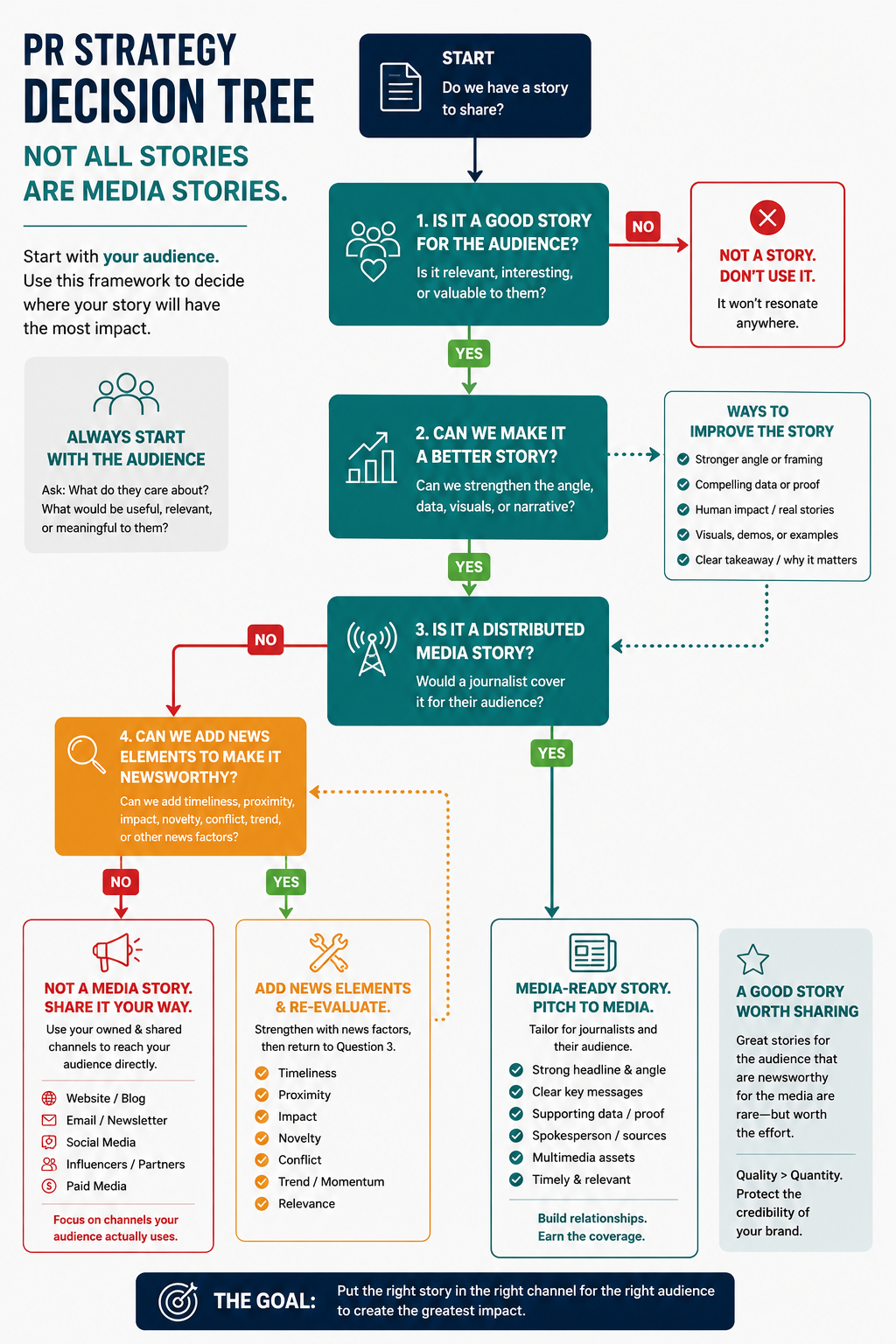
The coding-school example is essentially the process I still use today. When a client brings us something they want to talk about, I don’t immediately start thinking about reporters, press releases or media lists. I start working through a decision tree. The goal isn’t necessarily to turn everything into an earned media story. It’s to figure out whether we have a good story, whether we can make it better, and ultimately where and how to tell it.
1. Is this actually a good story?
This is probably the hardest question because it requires you to remove yourself and your own bias from the equation. Is this interesting to the audience, not just to us? Would someone who doesn’t work here find it interesting, useful, surprising or meaningful? It’s amazing how difficult that can be to answer objectively when you’ve spent months developing a product, raising money, building a new service or working on whatever it is you’re announcing.
This is also one of the reasons I believe there is enormous value in having an agency partner you trust enough to disagree with you. You need someone who understands your business and believes in what you’re doing, but is still willing to look you in the eye and say, “I don’t think this is a story.” That’s not cynicism. That’s strategy.
If the answer is yes, great. Keep going. If the answer is no, that doesn’t necessarily mean we give up. It means we ask the next question.
2. Can we make it a better story?
Sometimes the story you are handed isn’t the story you should tell. That’s exactly what happened with the coding school. The announcement was that they had launched a coding school and raised some money. The actual story was that a custodian and a coal miner had completely changed the trajectories of their careers.
Finding that better story usually requires digging. Can we find a stronger angle or connect what we’re doing to an emerging trend? Is there an interesting partner involved? Do we have compelling data or proof? Is there an actual person experiencing the impact of whatever we’re announcing? Do we have great visuals, demonstrations or examples that make it tangible? Most importantly, can we clearly explain why this matters to someone who doesn’t work here?
Product launches are a great example. Unless you’re Apple launching an iPhone, the simple existence of a new product probably isn’t particularly interesting to a broad audience. But maybe your customers are using it in a way nobody expected. Maybe you have proprietary data showing a dramatic change in behavior. Maybe the technology suddenly makes something possible that wasn’t possible six months ago. Or maybe there’s a fascinating person whose life or business has been materially changed by it. Now we’re getting somewhere.
If we can make the story better, we do it. Then we ask another important question.
3. Is it actually an earned media story?
This is where PR people sometimes get themselves into trouble because a good story doesn’t automatically equal a media story. Would a journalist actually look at what we’ve assembled and believe it’s worth telling to their audience? Sometimes the answer is still no, and that’s perfectly fine.
One of the strange things about PR is that we’ve somehow allowed earned media to become the ultimate validation of whether a story is worth telling. It isn’t. You have a website, newsletter, social channels and executives with LinkedIn audiences. You have customers, employees, partners, influencers and salespeople. There are dozens of ways to tell a good story that don’t require convincing a journalist to tell it for you.
The objective isn’t to shove every story through the earned-media hole. The objective is to put the right story in the right channel for the right audience.
Sometimes, however, we’ll look at a story and think we’re close. It’s interesting and relevant, but it doesn’t quite have enough to get a journalist over the finish line. That’s when we move to another branch of the decision tree.
4. Can we add news elements?
Journalists have been evaluating stories against some variation of the same criteria forever: timeliness, proximity, impact, novelty, conflict, trend, momentum and relevance. If we have an interesting story that isn’t quite newsworthy, the question becomes whether any of those elements already exist around it and can strengthen the story.
Maybe the product launch isn’t interesting by itself, but you have proprietary data showing a dramatic change in customer behavior. Maybe you don’t have your own data, but credible third-party research shows that your company is part of a much larger shift. Maybe there’s a surprising human consequence or some tension between the old way of doing something and the new way. Maybe you have a demonstration that makes somebody sit up and say, “Wait. It can do that?”
There is an important distinction here. We’re not manufacturing news. We’re looking for the news that already exists around the story. If we find it, great. We strengthen the story and reevaluate it. If we don’t, we stop trying to make the story something it isn’t.
5. Where should the story live?
Once we have a good story, the question should become much bigger than, “Who should we pitch?” Maybe earned media is part of the answer. Maybe it’s owned content, social or paid. Most likely, it’s some combination of all of them.
Go back to our coding-school graduates. Their stories became earned-media pitches, but they could also become feature stories on the company’s website. Their photographs and quotes could become social content. A short interview could become a Reel. Their transformations could become part of a sales presentation or case study. A salesperson could email a prospect, “Here’s what this actually looked like for someone who went through our program.” The same basic story could become newsletter content, executive thought leadership, recruitment material or paid social.
This is one reason I believe one great story can feed an entire communications ecosystem. That’s much more powerful than sitting around every Monday morning asking what “content” we need to create this week. Find the stories first, then figure out all the different things those stories can become.
Sometimes the answer is no
There is one final branch on the decision tree that I think PR people need to get much more comfortable with: stop.
Sometimes you work through the entire process and discover something uncomfortable. It’s not a particularly good story. You can’t make it significantly better. There isn’t a meaningful news element, and reporters probably aren’t going to care. So don’t pitch it.
That doesn’t mean it doesn’t matter. Put it on the website. Send it to customers. Give it to sales. Post it on social. Target a small vertical audience that genuinely cares about it. Just don’t burn your relationships trying to convince the entire world that something is fascinating when it isn’t. Good PR requires enthusiasm, but it also requires judgment.
After more than two decades of doing this, I’m still amazed by how often the truly great stories are the ones nobody thought to tell us about. They’re buried throughout organizations: an engineer experimenting with something weird, a customer doing something nobody expected, an employee with an incredible backstory, a dataset nobody thought to analyze, or even a spectacular failure that taught the company something important.
Or maybe it’s a group of people getting together next Thursday to build AI agents that might solve some incredibly difficult healthcare problems, and someone casually mentions it 45 minutes into a status call.
“Wait. You’re doing what?”
That’s probably the story.
Maybe instead of constantly asking, “What do we want to announce?” communications teams should spend a lot more time asking, “What’s happening inside this organization that someone outside these walls would genuinely want to know?”
Because the goal isn’t to cover everything. It’s to find the stories worth telling, make them as compelling as we can, and put them where they’ll have the greatest impact.
And sometimes the most valuable thing a PR person can tell a client is, “That story is just OK; let’s see if we can make it better.”
