
How to Build a Media Kit Journalists Will Actually Use
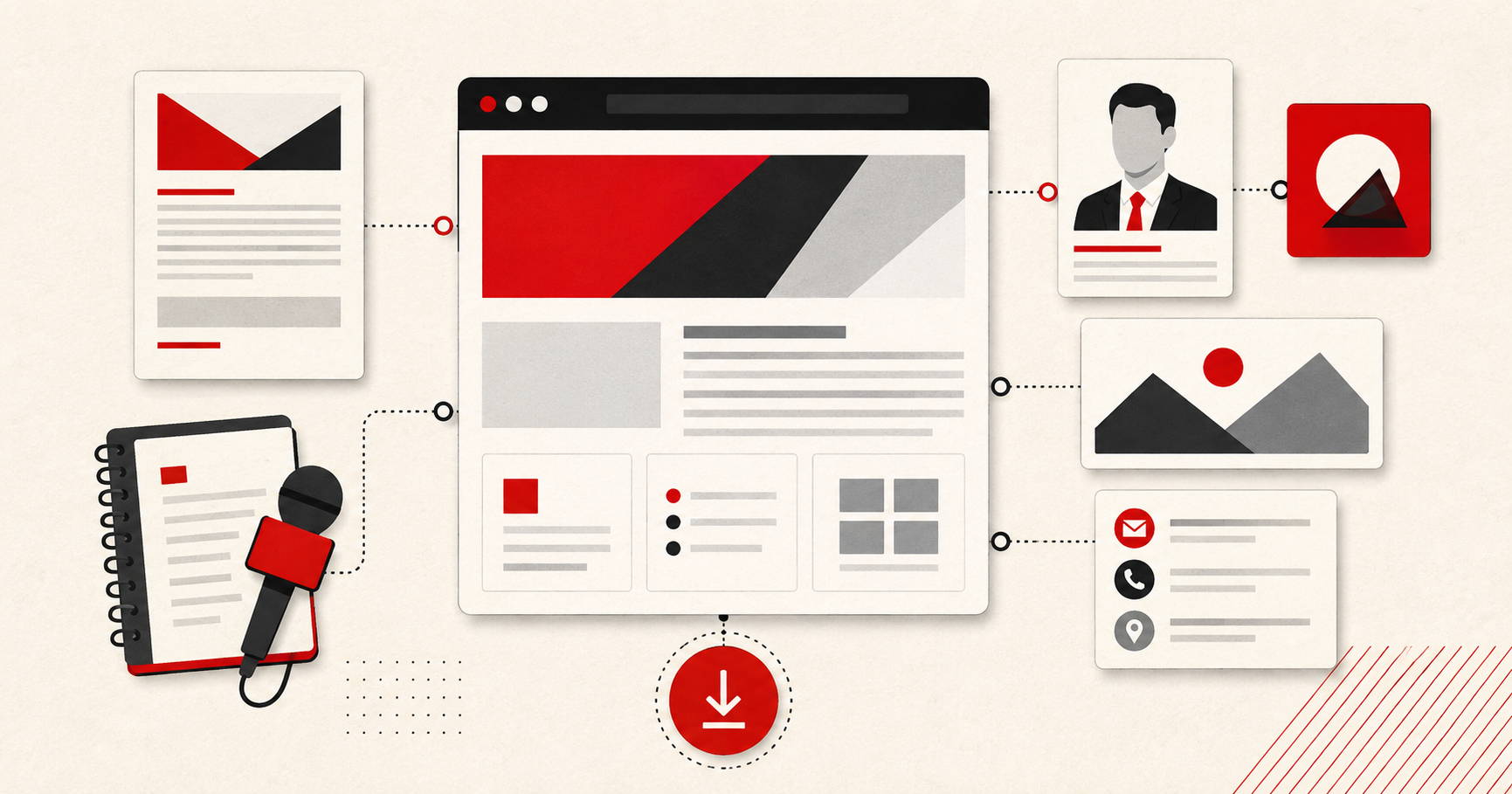
Your media kit should make a reporter’s job easier
A media kit is not a digital brochure, and it should not read like one. Its job is much more practical: give a reporter, producer, podcaster or creator the information they need to understand your company and tell an accurate story about it.
The best media kits answer the obvious questions quickly. What does the company do? Why does it matter? Who can speak about it? What has the company announced? Which images can be published? Who should a journalist contact when the deadline is in 20 minutes?
If those answers are buried across six pages—or trapped inside a PDF that has not been updated since the last rebrand—the media kit is creating work instead of removing it.
Start with the facts people repeatedly ask for
Before you build the page, collect the questions that already come up in media interviews, sales conversations and executive briefings. That list will tell you what belongs in the kit.
At minimum, include:
- A plain-language company description
- A short boilerplate that can be copied accurately
- Key facts, dates, locations and milestones
- Leadership names, titles and concise biographies
- Recent announcements and press releases
- High-resolution logos with usage guidance
- Executive headshots and approved brand photography
- Product images, screenshots or demonstrations when relevant
- Media coverage or notable recognition
- A clearly identified media contact
If your business uses technical language, add a glossary or a short “how it works” section. If you operate in a regulated or easily misunderstood category, include a factual FAQ. The goal is not to answer every possible question. It is to eliminate avoidable confusion.
Make the company description easy to quote
Most companies make one of two mistakes: they say too little, or they fill the page with language that sounds impressive but communicates almost nothing.
Write a one-sentence description that a smart person outside your industry can understand. Then add a slightly longer paragraph explaining the problem you solve, the audience you serve and what makes your approach different.
Avoid unsupported superlatives such as “revolutionary,” “industry-leading” or “best-in-class.” Specific facts are more persuasive. If you have credible numbers—customers served, markets reached, years operating or independently verified outcomes—include them with enough context to understand what they mean.
Give journalists usable visual assets
Images are often treated as decoration. In a media kit, they are working materials.
Provide horizontal and vertical logo files, versions for light and dark backgrounds, current executive portraits and several brand images that show the organization in action. Label each file clearly. “CEO-Jane-Smith-headshot.jpg” is far more useful than “IMG_7824-final-final.jpg.”
Add concise alternative text and captions that identify the people, place and activity shown. This improves accessibility, helps search engines understand the image and reduces the risk of someone being misidentified.
Make sure you have permission to distribute every asset. A photograph appearing on your website does not automatically mean a third party has the right to republish it.
Build a newsroom, not a document archive
A downloadable PDF can be helpful, but it should not be the only version of your media kit. A well-organized web page is easier to update, easier to search and easier to use on a phone.
Create a central newsroom or media page and link it from the website footer. Keep current facts directly on the page, then provide downloads for high-resolution assets and longer background materials.
Use clear headings that match the questions people actually ask: “What does the company do?”, “Who leads the company?”, “What has the company announced?” and “How can the media get in touch?” This structure helps human readers scan the page and gives search engines and AI systems clearer context.
Think about AI discovery without writing for a robot
AI search has made clarity even more important. Language models frequently assemble answers from concise, structured, corroborated information. Your media kit can become one of the strongest sources of truth about your organization—if it is current and explicit.
State the official company name consistently. Clearly identify leaders and their roles. Explain where the organization operates, what it offers and whom it serves. Link to relevant service, product and case-study pages. When you make a significant announcement, update the media kit rather than leaving conflicting facts in multiple places.
There is no magic “LLM keyword” field. Clear writing, sound page structure, descriptive metadata, useful internal links and consistent facts do far more than stuffing the page with search phrases.
Treat the media kit as a living resource
Assign an owner and review the kit at least quarterly. Update it after leadership changes, funding rounds, acquisitions, rebrands, major product launches or meaningful company milestones.
A simple test is to send the page to someone who does not work for the company. Ask them to explain what the organization does, identify the right spokesperson and find a publishable image. If they struggle, a time-pressed journalist will struggle too.
A strong media kit will not create news on its own. It will, however, make a good story easier to understand, verify and publish—and that is exactly what it should do.
Ready to make your media kit useful?
Need a media kit that gives journalists a clear, credible picture of your organization? Ampliphi can help you organize the story, build the assets and create a newsroom that is ready when opportunity arrives.
Explore our Public Relations & Media Relations and Executive Portraits & Brand Photography services. You may also find our guides to writing a press release and choosing a distribution strategy useful.
